This past summer (2025), I spent a month in Dresden to complete necessary archival research for a dissertation chapter entitled “The Aesthetics of Athletics: Health, Beauty and Reproducibility.” In it, I analyze exhibition materials from the widely successful Internationale Hygiene-Ausstellungen in Dresden of 1911 and 1930 to investigate how multinational public health (world’s) fairs and the circulation of mass media informed “modern” conceptions of corporeal aesthetics—and eugenics—across national boundaries.
This work sits at a key juncture in my dissertation, “Sports, Illustrated: The Making of the Global Image in Sports Photography, 1900-1974.” It examines how modern media culture—photography, film and television—evolved via the depiction of the sporting body. The Internationale Hygiene-Ausstellungen held in Dresden in 1911 and 1930 were landmark events that reshaped the public understanding of health, medicine and exercise. They popularized modern hygiene practices, showcased advances in medical science and made complex scientific ideas accessible through large-scale displays, models and interactive exhibits. These exhibitions also show how, by communicating scientific knowledge to broad audiences, public events and museums influenced the development of public health education across Europe. Indeed, before the Olympics became the global mass spectacle we know today, the Hygiene-Ausstellungen were key places for the formulation of twentieth century “body politics” on an international scale.
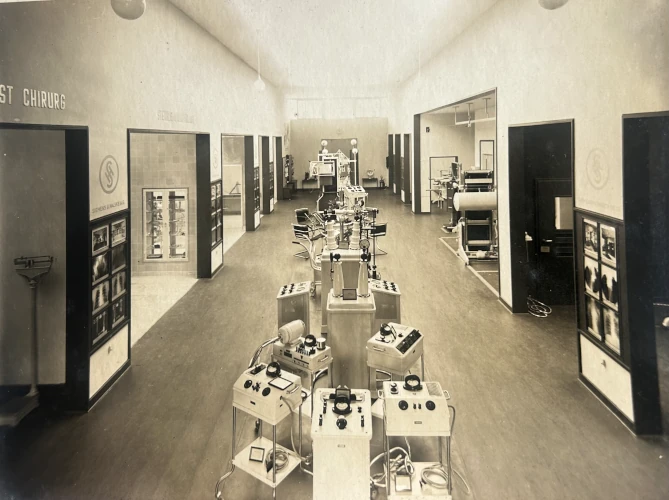
Upon my arrival in Dresden, I first visited the Library and Special Collections of the Deutsches Hygiene-Museum where archivist Marion Schneider was enormously helpful in sharing the photographic collections concerning the 1911 and 1930 expositions. She explained that several photographers had been officially commissioned to document the fairs and that the Museum had established a photography department to record its exhibitions and create educational materials. Although most of these images were destroyed in 1945, so I could only view the department’s surviving photographic and paper documentation. In addition to the photographic material, I examined posters, postcards, pamphlets, maps and other ephemera from the two Hygiene-Ausstellungen. This helped me to visualize the educational pavilions (see post image, above) and understand how complex medical and scientific information about the body was made digestible and even visually appealing to a wide audience.
After my work at the Deutsches Hygiene-Museum, I conducted research at Sächsische Landesbibliothek und Universitätsbibliothek Dresden (SLUB), the Dresden Stadtarchiv, and the Sachsen Staatarchiv – Hauptstaatsarchiv Dresden. The SLUB has an extensive photography collection, especially for the period that interests me. I found most helpful its holdings of Dresden-based architectural photographer Else Seifert, who captured images of the interiors and exteriors of expo buildings in 1930. My visit to the Stadtarchiv was particularly helpful in enabling me to understand the organizational underpinnings of the 1911 and 1930 events. Materials there included invitations to foreign leaders (1911), lists of guests of honor and invited press (1930) and a full version of the “official newspaper” published for the 1930 edition.
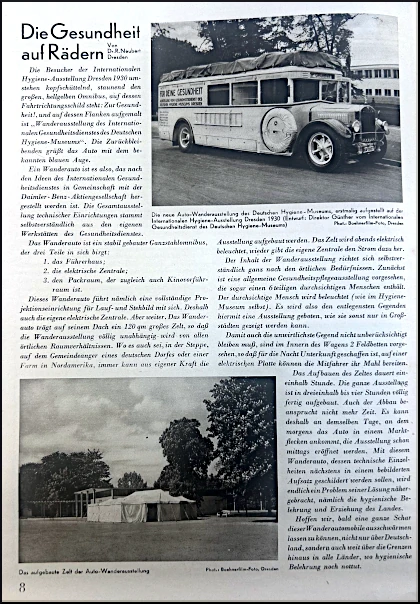
My discoveries at the Sachsen Staatsarchiv–Hauptstaatsarchiv Dresden augmented these findings, above all newspaper clippings from the popular press, which often featured impressions from the public about their visits to the expos. It also had further documentation on the organization of various national pavilions, as well as materials concerning the (inter)national travel of educational hygiene materials. My favorite find from these archives was material about the Deutsches Hygiene-Museum’s “health on wheels” exhibition bus (see image on the right), which drove around Germany filled with graphs, models and photographs to educate audiences about their bodies. These archival materials—which I was able to consult due to the generous support of the CEHS—will help me frame the pedagogic role of photography at a key junction in the increasing internationalization of physical culture.