
For my project, “‘Out of Love’: Public Health for Plague Victims in Early Modern Central Europe,” I traveled to Munich, Germany to conduct research for my dissertation. During my three week stay, I carried out research at the Bavarian State Archives, Munich State Archives, and the Munich City Archives.
In my dissertation, I am particularly interested in Duke (and later Elector) Maximilian I of Bavaria (b. 1573-1651) who not only transformed the Bavarian state before and during the Thirty Years War, but also reformed the Bavarian healthcare system. Before this trip, I had discovered that Maximilian increasingly promoted physicians with practical experience and was seemingly developing a hierarchy of competence in the public health system.
My goal for the trip was to look at sources pertaining to the Bavarian public health system during the first half of the seventeenth century. In particular, I was interested in Malachias Geiger, a young court physician who championed his practical experience working with the human body rather than basing all his advice merely on his scholastic training.
In Munich, I found Geiger’s final testament (which included an extensive list of almost everything he owned) but also letters confirming pay increases that rewarded his good practice. Furthermore, I located some of his letters with Maxmilian, as well as documents from his father, who had worked his way up from a barber-surgeon to head Bavarian Army surgeon by the beginning of the Thirty Years War.
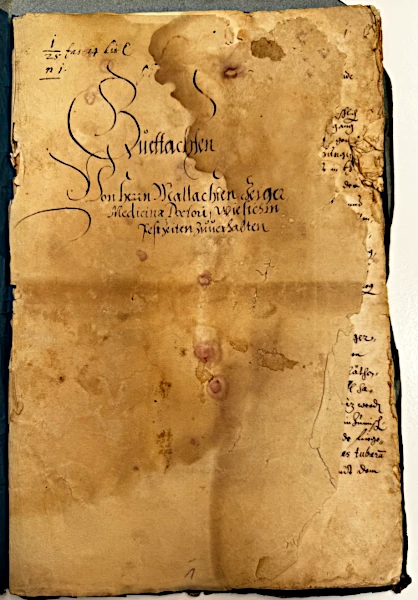
Most importantly, deep within a massive stack of documents I found an unpublished manuscript by Malachias Geiger, dedicated to Maximilian, which I believe was written in 1648 just as the war ended (see accompanying image). The manuscript details how clergy, politicians, and physicians should respond to a plague outbreak. Naturally, it focuses largely on the physician’s perspective and how political authorities can support them. However, just like Geiger’s other works, and particularly those dedicated to Maximilian, its advice was derived, as Geiger put it, “from my own practice and experience.” As best as I can tell, no other modern scholar has utilized this manuscript.
This manuscript is an especially important find. By the time that I had finished with Geiger’s final testament and the other documents, I already had enough for a dissertation chapter. Now that I have found the unpublished manuscript as well as a variety of other sources (reports on plague outbreaks, even the actual cost of some plague outbreaks in particular years), I have enough material to fill out additional chapters. This will lead to a greater understanding of how early modern states in Central Europe attempted to centralize their authority, placing them in conversation with other states like France or England, but with public health at the center. I would like to thank the Central European History Society for its generosity in supporting my research. The research that I conducted with the help of the CEHS grant will be a massive boon to my dissertation. I wholeheartedly appreciate the assistance I was provided with, and I look forward to sharing the results of the research conducted during this trip with the Society.