

My book manuscript, Dependent States: Family, Care, and Welfare in Britain, France, and West Germany, 1957-1996, examines the entangled transformation of family care and national welfare in Britain, France, and West Germany after 1957. It tracks a series of political campaigns and policy reforms to support families outside the family wage: widowed and single mothers, migrant families, workers and children with disabilities, and the dependent elderly. Though these campaigns began in the age of affluence, new policies were realised only after the end of the economic boom in the 1970s and 1980s. Far from an anomaly or a contradiction amid welfare austerity, Dependent States reveals how new programs for caregivers became an essential feature of economic reform in post-industrial Western Europe.
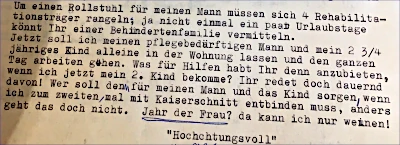
With support from a research and travel grant from the Central European History Society, I was able to explore further the peculiar and often counterintuitive place of West German family policy in this broader international story. I began at the Bundesarchiv in Koblenz with the records of the so-called “84 Commission,“ a group established by the Schmidt government to plot out new protections for women and survivors. The files showed that the committee worked hard to establish a gender-neutral pension formula that still gave mothers – now caregivers – an independent right to claim. In a Commission that collected evidence from academics, feminists, unions, and insurance companies, I was struck by the immediate consensus that motherhood was full-time, lifelong work. Yet the Commission records also showed the limits of such entitlements. One woman wrote a plea for support as she cared full-time for her child and her husband, who could not work due to disability. In France and Britain, it was precisely these gaps around family disability that propelled new protections for care. The silent response of the “84 Commission,” by contrast, underscored the grip of marriage and motherhood on the West German system well into the 1980s. “Year of women?,” the woman’s letter closed: “At that I can only cry!”
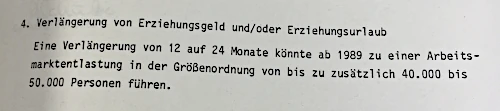
The “84 Commission” was an SPD project of the 1970s, but it reported in 1984 to a new government under the CDU’s Helmut Kohl. In the second half of my research in Koblenz, I therefore combed the records of the BMA, the BMI, BMJFG, and the Chancellor’s office to reconstruct how the report was implemented via Erziehungsgeld and Erziehungsurlaub. Based on research in Britain and France, I expected this parental leave to relate in some way to parallel labour market reforms. Still, I was floored at how overt these links were in West Germany. Memos predicted that Erziehungsgeld would reduce unemployment by 60,000 within a year. Accompanying plans sought to bolster part-time and contract work, as parental leave created new jobs the unemployed could fill. With care now a brief period of leave rather than a lifelong task, the government also expanded paid eldercare and hospital work, laying the groundwork for the future long-term care insurance. The records thus made explicit how governments in the 1980s sought to simultaneously support family care and to ease economic realignment. Family and the economy were managed at once.
Such measures, of course, were deeply contested and, in my final week of research, I unearthed protests and legal campaigns among feminists, unions, socialists and others in the Historical Archives of the European Union. Situated in the hills of Fiesole on the beautiful campus of the EUI, the Historical Archives are an underused resource to understand how political groups coordinated across European borders. In Florence, I focused on heated debates over working time in the European Parliament, which featured an unparalleled number of female politicians after 1979, and in the Economic and Social Council. The records showed a growing consensus among feminists and the left that measures on working time should also protect family life, to allow care and work to be performed by all. They also revealed, however, the near total disinterest of business and unions in this project. Such ambivalence, I found in the papers of Femmes d’Europe, was compounded by the economic orientation of the European Community, whose limited competence over family matters was stressed by governments and later confirmed by the Court. European institutions thus enabled activists to consolidate campaigns and to cement new political frameworks around care. These frameworks, however, ran into institutional barriers as they were twisted from the 1980s to new political ends.
All this research helped me to understand how leftist campaigns and policies we might normally associate with the 1970s were often realised, albeit in unexpected ways, in the more conservative decades that followed. This CEHS research grant thus allowed me to make crucial progress in transforming my dissertation into a book and, in doing so, to think more deeply about social reproduction and economic transition in the late twentieth century.