
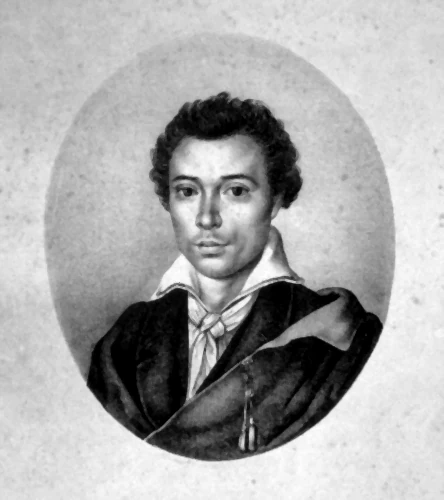
With the generous support of the Central European History Society, I was able to draft the first scholarly article ever on the Black writer and state-employed mining engineer Eduard von Feuchtersleben (1797-1857).
Von Feuchtersleben was an extraordinary figure: a Black man who managed to rise through the ranks of state mining operations and publish a wide variety of texts at a time when the corpse of his grandfather, Angelo Soliman, was still held in the collection of the Habsburg ethnographic cabinet. And yet, he is virtually unknown even among specialists. The few mentions of von Feuchtersleben in scholarly literature all occur in asides of texts focusing on his grandfather. These asides routinely offer the same argument: that his writings were of poor quality and did not address either his grandfather’s horrific fate or his own Blackness and are, therefore, not worthy of serious study. My article challenges this position. Specifically, by demonstrating that von Feuchtersleben’s writings from the mid 1820s contain a subtle and sophisticated account of modern alienation that combined three unique aspects: an inside perspective on mining as a key industry of global extractivism, the aesthetics of German Romanticism, and the perspective of a Black man living at the center of a continent hostile to his Blackness.
Von Feuchtersleben managed to do this within five years of Hegel’s classic treatment of alienation in his Elements for a Philosophy of Right (1820)—and more than 125 years before Frantz Fanon centered the Black subject in theories of alienation and James Baldwin situated this subject in the cultural geography of Central Europe. Ultimately, my analysis of his work aims to show that histories of alienation that get to Fanon, Baldwin and beyond only via the familiar way points of Rousseau, white Romanticism, Hegel, and Marx are not just inaccurate but also perpetuate a line of thinking in which Black thought is always only an afterthought.
The CEHS grant allowed me to spend July and part of August 2025 in Vienna, where I was able to access to Feuchtersleben’s full written corpus. Due to its hetereogeneity—he wrote plays, poems, and travelogues as well as essays in mining engineering—this corpus is dispersed across obscure and largely undigitized journals. A key guide for me here were the eventually aborted plans for an edition of von Feuchtersleben’s collected works, contained in the papers of his white half-brother Ernst. Finally, from my base in Vienna, I was also able to access the key institutions that von Feuchtersleben’s life traversed, putting his biography, which I had retraced using secondary sources, on stable ground via certificates and other documents. My travels this summer—impossible without the CEHS’s support—took me from Kraków, Poland (von Feuchtersleben’s place of birth) to Vienna’s Löwenburgkonvikt and the Bergakademie Schemnitz in present-day Slovakia to Ausee, where he was Südhüttenmeister from 1832 to his death in 1857.