
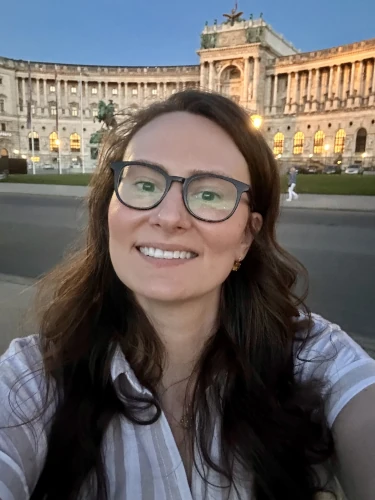
From August 16 to September 16, I conducted a month-long research trip in Vienna, working primarily at the Wiener Rathausarchiv, where I consulted historical newspaper collections to investigate the political, artistic, and emotional labor of Marianne Beskiba (1874–1912). My goal was to reconstruct Beskiba’s contributions to the Christian Social women’s movement surrounding Mayor Karl Lueger (1844–1910) and to integrate these findings into a broader theoretical framework of affective sovereignty, which examines how emotional infrastructures and gendered labor uphold political authority within nationalist and far-right movements.
During my time in Vienna, I identified, collected, and transcribed dozens of primary sources documenting Beskiba’s activities between roughly 1900 and 1911. These materials include organizational minutes, annual reports, ceremonial descriptions, political speeches, and partisan press commentary. The documents reveal Beskiba’s repeated election as Schriftführerin (secretary) of the Margareten women’s group, as well as her administrative responsibilities across Wieden, Ottakring, and Leopoldstadt-Brigittenau. She handled record-keeping, coordinated membership drives, and served as an official delegate to large district assemblies, often appearing alongside senior Christian Social officials such as Vice-Mayor Josef Neumayer, City Councillor Oppenberger, and District Director Josef Hofstätter.
The archival evidence also illuminate Beskiba’s role as an artist and symbolic producer. Multiple articles document her creation and donation of political and devotional objects—including portraits of Lueger, embroidered banners, and ceremonial flags—that were used in public religious rituals and consecrations, particularly in the Carmelite Church. These objects served as material expressions of Christian Social identity, blending Catholic devotion with political mobilization. Beskiba further acted as Fahnenpatin (flag sponsor) for several district women’s groups, solidifying her influence beyond Margareten.
In addition, the research highlights Beskiba’s role as a cross-district connector within Christian Social activism. She regularly appeared as an honored representative at large gatherings attended by the party leadership. Newspaper accounts of speeches by Lueger himself reveal how women’s groups were emotionally and symbolically integrated into Christian Social political strategy.Lueger framed women as moral anchors, embodiments of Catholic virtue, and essential transmitters of party loyalty, demonstrating the emotionalized rhetoric that underpinned the movement.
Finally, the sources document the political scandal that followed the publication of Beskiba’s 1911 memoir, Erinnerungen an Dr. Karl Lueger, which provoked fierce reactions across Christian Social, liberal, and socialist newspapers. Her once-valued emotional closeness to Lueger was recast as betrayal, moral transgression, or political weaponry. This trajectory—from trusted insider to public political scandal—provides a vivid example of how affective bonds that sustain political authority candestabilize it when redirected.
Taken together, these findings deepen my theorization of affective sovereignty by showing how Beskiba’s administrative, artistic, and emotional labor helped generate the moral legitimacy and symbolic cohesion of Christian Social politics. At the same time, her later rupture with the movement demonstrates the volatility of emotional authority when personal loyalty, political memory, and public narrative collide.
This research trip enabled me to uncover a substantial body of underexamined material, reconstruct Beskiba’s political and artistic trajectory, and integrate these insights into a dissertation chapter on gendered political emotion, nationalism, and conservative mobilization in fin-de-siècle Vienna.