
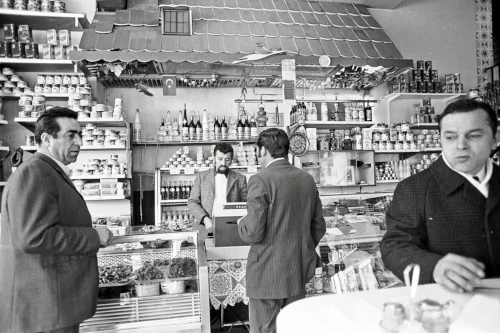
With the generous support from the Central European History Society, during the summer of 2025 I completed the final research toward my dissertation, “Revisiting the Right to Stay: Vietnamese Migrants in Postwar Germany, 1978-2000,” and began preliminarily research toward my second project,“From Đồng Xuân to Eurogıda: Migration and Food Politics in Contemporary Germany.”
The CEH grant allowed me to visit archives across Germany. I examined files at DOMiD (Dokumentationszentrum und Museum über die Migration in Deutschland) in Cologne, the German Federal Archives in Berlin, the Berlin State Archives, and the Leipzig Bürgerbewegung Archiv. I also read through newspaper articles at the Berlin State Library.
I began my research at DOMiD, finding menus, interviews with migrants about supermarkets, and files on self-employment. I also collected newspaper articles about Turkish workers and stores from the 1970s through the 1990s and stories on German unity. I continued my research at the Federal Archives in Berlin. Some of the files I read contained letters written by East Germans about foreign workers. Others had information about the Treuhandanstalt and the purchase of East German Kaufhallen after 1989 by West German firms, as well as the closure of grocery stores and plans for how to use these spaces. At the Berlin State Archives, I examined files related to foreign life in West Germany and post-reunified Germany; they included information about policing migrants and about about the building of communal spaces in migrant-dense neighborhoods such as Neukölln in the 1980s. At the Archiv Bürgerbewegung, I found sources on migrant laborers in the former East in the early 1990s, the protest movement in Leipzig in the late 1980s, migrant laborer and environmentalism, as well as a collection of magazines from Leipzig in the early 1990s.
My trip to Prague was a highlight of my summer research endeavors. In the Czech capital, I visited the Vietnamese market, speaking to people in both Vietnamese and German. I compared the market with the Đồng Xuân market in Berlin. I also met people who were born in Vietnam, living in Munich, and visiting their relatives in Czechia. This excursion deepened how I am thinking and writing about Vietnamese in eastern Germany in the final chapters of my dissertation. It has also helped me think about the scope of my second project. My trip to Prague and my conversations with people there have shaped my understanding of the transnationalism of Vietnamese markets in Central Europe and have informed how I conceive migrant-owned businesses.
Thanks to this support from the Central European History Society, I was able to complete the final chapters of my dissertation and create a rough timeline for my second project. Using this research, I presented a very early draft of a paper, “Consuming at the Kaufhalle : Migrant Laborers, Food, and the Creation of Home in East Germany,” for the “Food, Migration, and Belonging in 20th Century European History” conference at the German Historical Institute Pacific Office in September 2025. In the future, I hope to expand this conference paper into an article.